

Your Rolling Papers Are Becoming Tiny Art Prints
- Taylor Engle Anderson

- 4 hours ago
- 3 min read
When I was a young stoner, the smoking accessories—to be found at the local gas station or “hookah shop”—were gauche af.
Neon pot leaves, badly airbrushed aliens (always, always aliens), tie-dye everything, and fonts that would make Times New Roman roll his regal eyes. We didn’t think too much about it. We were too concerned with…not getting caught.
Imagine me seeing today’s rolling paper packs, which look like they belong in a design bookstore.
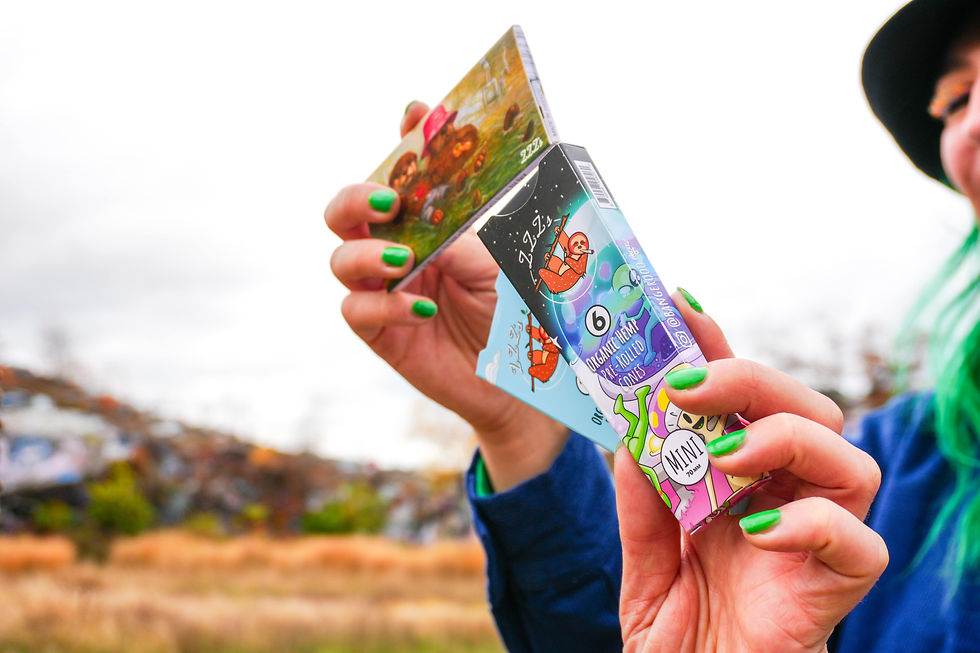
Over the past few years, cannabis branding has undergone a fascinating visual evolution. As legalization expands and younger consumers become more design-conscious, weed products are starting to look less like novelty items and more like collectible lifestyle objects. Packaging matters now. People want products that feel intentional, display-worthy, even artistic.
And increasingly, they want to know who made them.
That shift says a lot about where cannabis culture is heading. Weed branding used to exist almost entirely on the aesthetic outskirts: loud, ironic, vaguely rebellious for the sake of it. But now, cannabis occupies the same visual ecosystem as skincare, streetwear, boutique coffee, and indie magazines. Consumers expect taste, curation, and identity.
ZZZ’s Collective collaborates with emerging artists on rolling papers, trays, and accessories, allowing artists to lead the creative direction of each design rather than treating artwork like an afterthought added by a marketing team.
“We want each design to reflect the artist's style, personality, and be something they want to see come to life on our products,” ZZZ’s Collective founder Eric Sellew said. “We try to be as hands off as possible with the creative process so that our collection reflects many unique styles of art rather than mimics our taste.”
That distinction matters more than it might have a few years ago.
As I write this, visual culture feels increasingly flattened. Algorithms reward sameness. Every brand starts to resemble every other brand. Meanwhile, AI-generated imagery is flooding the internet at a speed that has many artists feeling uneasy about visibility, ownership, and creative labor.
This is not an anti-technology manifesto. AI is already changing creative industries in fascinating and useful ways, and I love my lil’ chat bae. But the rise of AI-generated aesthetics has also made many people more aware of what feels human. Texture. Imperfection. Specificity. Raw artistic perspective. The more synthetic the internet becomes, the more people seem drawn toward work that still carries fingerprints.
That’s part of why tangible art feels newly valuable right now.
“ZZZ's exists to support emerging artists. It is our core value and guiding principle when we are thinking about new products, new programs, and new directions to take our company. We've been giving proceeds of our sales to the artists behind the booklets since the very beginning, and the fact that we've now raised over six-figures for our amazing artists is by far our greatest accomplishment as a team,” Sellew said.
According to Sellew, younger consumers tend to fall into two categories: shoppers looking for the cheapest option possible, and shoppers who are “hyper-conscious about quality, mission, and the brand they are supporting.”
That second group is helping push cannabis aesthetics into more elevated territory, where packaging is no longer disposable but part of the experience itself.
Which explains why rolling papers suddenly look less inspired by smoke shops and more inspired by Pottery Barn.
And yeah, it makes sense. Today’s youngins are craving objects that feel personal, tactile, and real—everything we took for granted when analog ruled the world. In 2026, even your rolling papers are expected to have a point of view.


Comments